Monday InsightsIssue 5 · Nov. 23, 2026
The budget passes, B.C.’s new cabinet and Carney meets Xi
Last week, the budget passed the House, B.C.’s Conservative government was sworn in, Carney and Xi cut some tariffs and Alberta tabled its new riding map. Here’s what happened and what it means for you.
The week in four numbers
In five minutes
The week in brief
Trade. Prime Minister Mark Carney and Chinese President Xi Jinping met in Shenzhen on Nov. 17. China will drop its 25 per cent tariff on Canadian pork and some seafood. There was no new deal on autos.
Ottawa. The budget passed the House of Commons 162 to 151. Inflation held at 3.1 per cent, highest in Nova Scotia at 5.9. Bank of Canada Governor Tiff Macklem will leave when his term ends in June 2027.
B.C. Premier Lorne Doerkson and a 25-member cabinet were sworn in Nov. 20. There will be no fall sitting.
Alberta. Bill 40 would put a 91-riding map into law, and the NDP says it will go to court if it passes. Bill 42 would keep large data centres off prime farmland and away from homes, and Bill 43 would let the province order some city bike lanes removed.
Legislatures. Manitoba opened a new session, and Newfoundland and Labrador passed its gas tax cut and approved the Bay du Nord oil project. Ontario and Nova Scotia Liberals elected new leaders.
Carney and Xi cut tariffs, but not on cars
Carney and XiShenzhen, Nov. 17
What changes with China
- ChinaDrops its 25 per cent tariff on frozen pork cuts, cold-water shrimp, Greenland halibut, some molluscs and sea cucumber
- ChinaOpens its market to Canadian fava beans, chickpeas and lentils
- CanadaTariff relief on 32 more Chinese steel and aluminum products where Canadian supply falls short
- CanadaA major trade mission to China in 2027
- AutosNo new agreement
The Canadian Press, Nov. 17 · Prime Minister’s spokesperson
What happened. Carney met Xi in Shenzhen on Nov. 17, before the Asia-Pacific Economic Cooperation leaders’ meeting. China will drop its 25 per cent tariff on Canadian frozen pork cuts, frozen cold-water shrimp, Greenland halibut, some molluscs and sea cucumber, about $400 million in exports a year, Carney’s spokesperson said. China will also open its market to Canadian fava beans, chickpeas and lentils. Canada will extend tariff relief to 32 more Chinese steel and aluminum products where Canadian supply falls short, and send a major trade mission to China in 2027. “Much has been achieved since my visit,” Carney said, The Canadian Press reports. China’s readout quotes Carney saying the two sides should “reduce the list of irritants, expand the list of cooperation.”
No auto deal. There was no new auto agreement. Carney said auto talks depend on trade negotiations with the United States. A day earlier, in Phnom Penh, he said Canada could turn to Chinese, European or Japanese automakers if those talks fail, and that any Chinese investment would need production in Canada: “There has to be a manufacturing aspect involved,” The Associated Press reports. Asked how Canada went from seeking 100 per cent tariffs on Chinese electric vehicles to possibly building them here, Finance Minister François-Philippe Champagne said “the world has changed,” CBC News reports. In January, Canada cut its tariff on Chinese EVs from 100 per cent to 6.1 per cent for up to 49,000 vehicles a year at first.
Autos at home. Ottawa and Ontario will each put about $464 million into Ford’s nearly $5-billion plan to retool its Oakville plant to build F-Series Super Duty trucks, up to 100,000 a year, the federal government announced Nov. 20. It says the project protects more than 2,000 jobs. “Canada is an auto nation, now and into the future,” said Industry Minister Mélanie Joly.
Also in Shenzhen. Carney met Mexican President Claudia Sheinbaum on Nov. 17, CP reports.

The budget passes, and prices hold
Budget voteHouse of Commons, Nov. 19
The budget passes, 162 to 151
All 162 yes votes were Liberal. Conservative, Bloc Québécois, NDP and Green MPs voted no.
House of Commons, vote 196 · via openparliament.ca
PricesConsumer Price Index, October
Where prices rose fastest
Provinces and territorial capitals. Canada overall: 3.1 per cent; 2.0 per cent excluding energy.
Statistics Canada, table 18-10-0004-01 · Nov. 16
PollsTwo national polls
Liberals lead in both
Abacus: online, 2,000 adults, Nov. 13 to 18. Liaison: automated phone, 1,000 Canadians, Nov. 8 to 21. NDP: 9 per cent (Abacus), 15 per cent (Liaison).
Abacus Data, Nov. 22 · Liaison Strategies, Nov. 23
The budget passes. The House of Commons passed the 2026 budget 162 to 151 on Thursday, Nov. 19, after four days of debate. All the yes votes were Liberal; Conservative, Bloc, NDP and Green MPs voted no. The government will now table one or more budget implementation bills, which go to committee and can be amended, The Canadian Press reports.
Prices. Prices were 3.1 per cent higher in October than a year earlier, the same as September, Statistics Canada reported Nov. 16. Excluding energy, they rose 2.0 per cent. Gasoline was up 30.9 per cent and groceries 2.0 per cent; cellphone service fell 6.2 per cent. Inflation was highest in Nova Scotia (5.9 per cent), P.E.I. (5.2) and Whitehorse (5.0), and lowest in Ontario and B.C. (2.5 each).
Bank of Canada. Governor Tiff Macklem will not seek a second term and will leave when his term ends June 2, 2027. “It has been the highlight of my career to serve as the 10th governor of the Bank of Canada,” he said Nov. 16. The bank’s board has begun a search; cabinet must approve its choice, CP reports. The next rate decision is Dec. 9.
Polls. Two national polls released in the past week put the Liberals ahead. Abacus Data, online, 2,000 adults, Nov. 13 to 18: Liberals 45 per cent, Conservatives 35, NDP 9, Bloc 7, Greens 3; 55 per cent approve of the federal government. Liaison Strategies, automated phone, 1,000 Canadians, Nov. 8 to 21: Liberals 41, Conservatives 32, NDP 15, Bloc 6, Greens 2. That is four points lower for the Liberals than Liaison’s previous update. “One update isn’t enough to call a new trend,” said Liaison principal David Valentin.
Strike votes. The Public Service Alliance of Canada began strike votes Nov. 16 for about 120,000 federal workers in three bargaining groups. Voting runs until Jan. 22, CTV News reports. The union called the wage offer of less than 1 per cent a year “insulting”; the Treasury Board said it was “disappointed” the union is voting while mediation continues, CP reported.
Flu season. In the week ending Nov. 14, 14.5 per cent of flu tests came back positive, 4,769 of 32,888, up from nearly 14 per cent the week before, the Public Health Agency of Canada reported Nov. 20. Most cases are influenza A. In the week ending Nov. 7, 665 people were admitted to hospital with flu. On Nov. 16, Montreal emergency rooms were at 150 per cent of stretcher capacity, The Globe and Mail reports.
A Conservative government is sworn in
CabinetSworn in Nov. 20
Doerkson’s cabinet: 25 members
- PremierLorne Doerkson
- Deputy PremierClaire Rattée, Social Development
- AgricultureIan Paton
- Attorney GeneralCaroline Elliott
- ChildrenKristina Loewen, Children and Family Development
- TechnologyBruce Banman, Citizens’ Services and Technology
- EconomyGavin Dew, Economic Development and Tourism
- EducationLynne Block, Education and Child Care
- EnergyLarry Neufeld, Energy, Mines and Petroleum Resources
- EnvironmentÁʼa:líya Warbus
- FinancePeter Milobar
- ForestsKiel Giddens
- HealthRyan Peterson
- IndigenousScott McInnis, Indigenous Relations and Reconciliation
- HousingCathie Ounsted, Local Government, Housing, Sport and Culture
- Post-secondaryKorky Neufeld, Post-Secondary Education and Labour
- SafetyJessy Sahota, Public Safety and Solicitor General
- TransportTrevor Halford, Transportation and Infrastructure
- Water and landDonegal Wilson, Water, Land and Natural Resource Operations
- StateCarson Binda, Red Tape Reduction
- StateAnna Kindy, Rural Development
- StatePete Davis, Mining
- StateZeeshan Wahla, Housing
- StateHarman Bhangu, Labour
- StateWard Stamer, Emergency Management
18 ministers, six ministers of state and the premier.
Office of the Premier of British Columbia · Nov. 20
LegislatureIf the recount holds
64 Conservatives, 27 NDP, 2 Greens
93 seats. A majority is 47. Kelowna Centre’s judicial recount starts Nov. 23.
Elections BC · Victoria News, Nov. 19
Sworn in. Sixty-three of the 64 Conservative MLAs were sworn in Thursday, Nov. 19. “Today we have elected a conservative government for the first time in more than a hundred years,” Doerkson said, Victoria News reports. NDP MLAs are sworn in Nov. 23 and Green MLAs Nov. 26.
The cabinet. Doerkson was sworn in as premier Nov. 20 with 18 ministers and six ministers of state. Claire Rattée is deputy premier and minister of social development. Peter Milobar has finance, Ryan Peterson health and Caroline Elliott is attorney general. Ministers of state cover red tape reduction, rural development, mining, housing, labour and emergency management, and 12 parliamentary secretaries were named. Kristina Loewen, whose Kelowna Centre seat is under judicial recount, is minister of children and family development. “British Columbians voted for change and our government is ready to deliver it,” Doerkson said. The government lists five priorities: affordability, the economy, health, public safety and “a strong and proud B.C.”
Parliamentary secretaries. Rosalyn Bird (Armed Forces and Veterans Affairs), Margareta Dovgal (Children and Youth with Special Needs), Steve Kooner (ICBC), Misty Van Popta (Infrastructure), Megan Knight (Metro Vancouver), Tracy St. Claire (Rural Health), Sharon Hartwell (Seniors), Mandeep Dhaliwal (Sport and Culture), Sacha Peter (Technology and Innovation), Jody Toor (Tourism), Harj Dhaliwal (TransLink) and Bryan Tepper (Urban Policing).
No fall sitting. Doerkson said Nov. 16 there will be no fall session. Ministers are “preparing a substantive legislative agenda for the spring,” he said in a statement, Victoria News reports. Promises that need new laws, including repealing the Declaration on the Rights of Indigenous Peoples Act and changing no-fault auto insurance, wait for spring.
The recount. Kelowna Centre’s judicial recount starts Nov. 23. Loewen led the NDP’s Loyal Wooldridge by 43 votes, 11,689 to 11,646. “Last time, it changed nothing at all,” Loewen said of the riding’s 2024 recount, the Kelowna Daily Courier reports.
A new riding map, and rules for data centres
Bill 42Tabled Nov. 18
New rules for data centres and wells
- HomesNo data centre of 10 megawatts or more within 600 metres of the nearest home
- FarmlandNone on irrigated land or Class 1 and 2 farmland, about 14 million acres
- PowerOperators pay for their own power hookups and cut use first in a grid emergency
- WaterA provincial standard aiming for close to zero cooling water
- FinesUp to $6 million for serious contamination by a corporation
- WellsCleanup money set aside for every new well drilled after April 1, 2027
Government of Alberta · Nov. 18 · Proposed, not yet law
Bill 43Introduced Nov. 19
Bike lanes and LRT
- New lanesNo new bike lane that takes road space from vehicles without the transportation minister’s approval
- Old lanesThe province could order some existing lanes removed during scheduled road work
- LRTProvincial approval for new or expanded LRT projects
- CostUp to $150 million to remove lanes built in the last decade, the Edmonton mayor estimates
- NextPremier Smith says amendments are coming
The Canadian Press, Nov. 19 to 21 · Proposed, not yet law
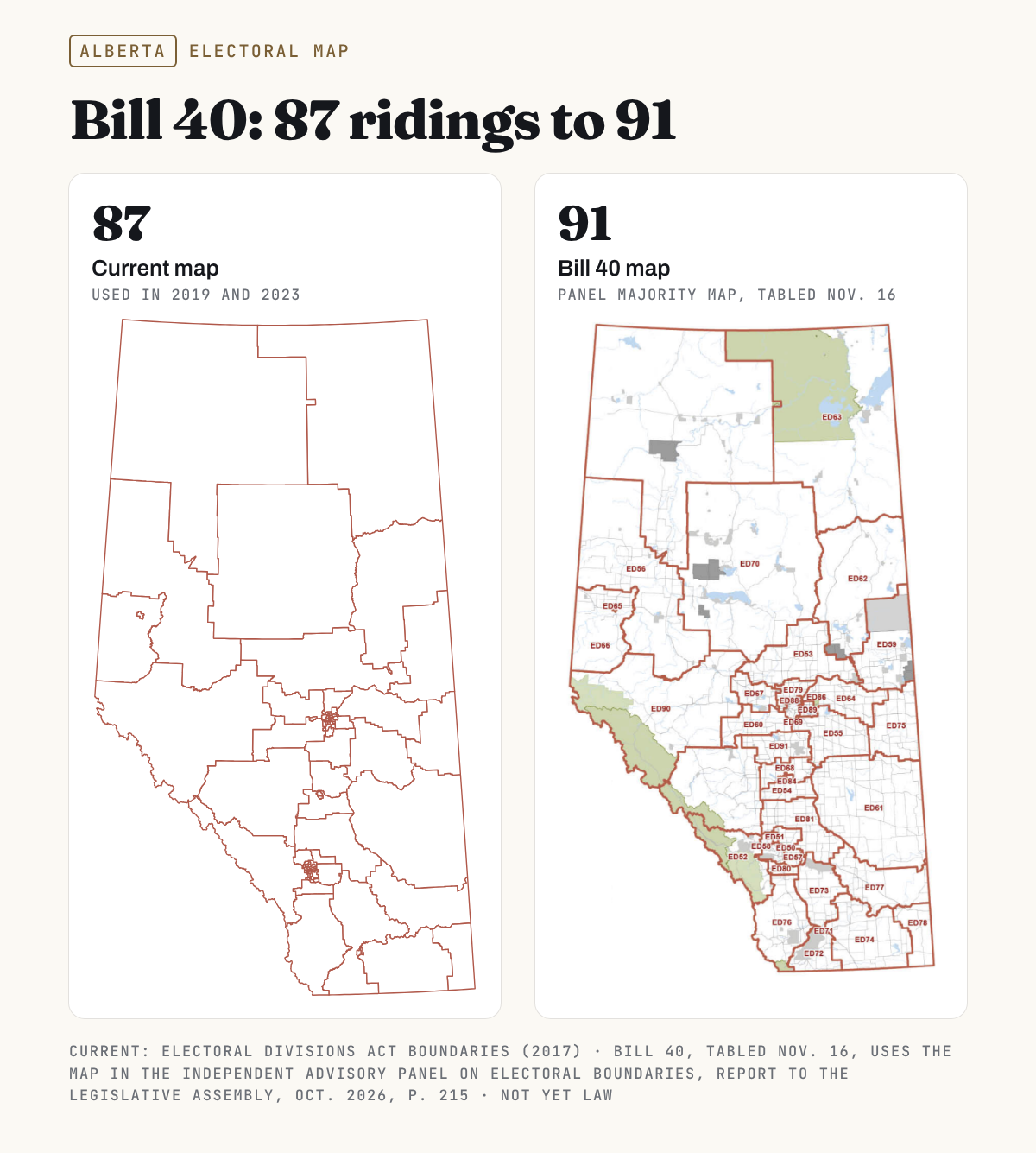
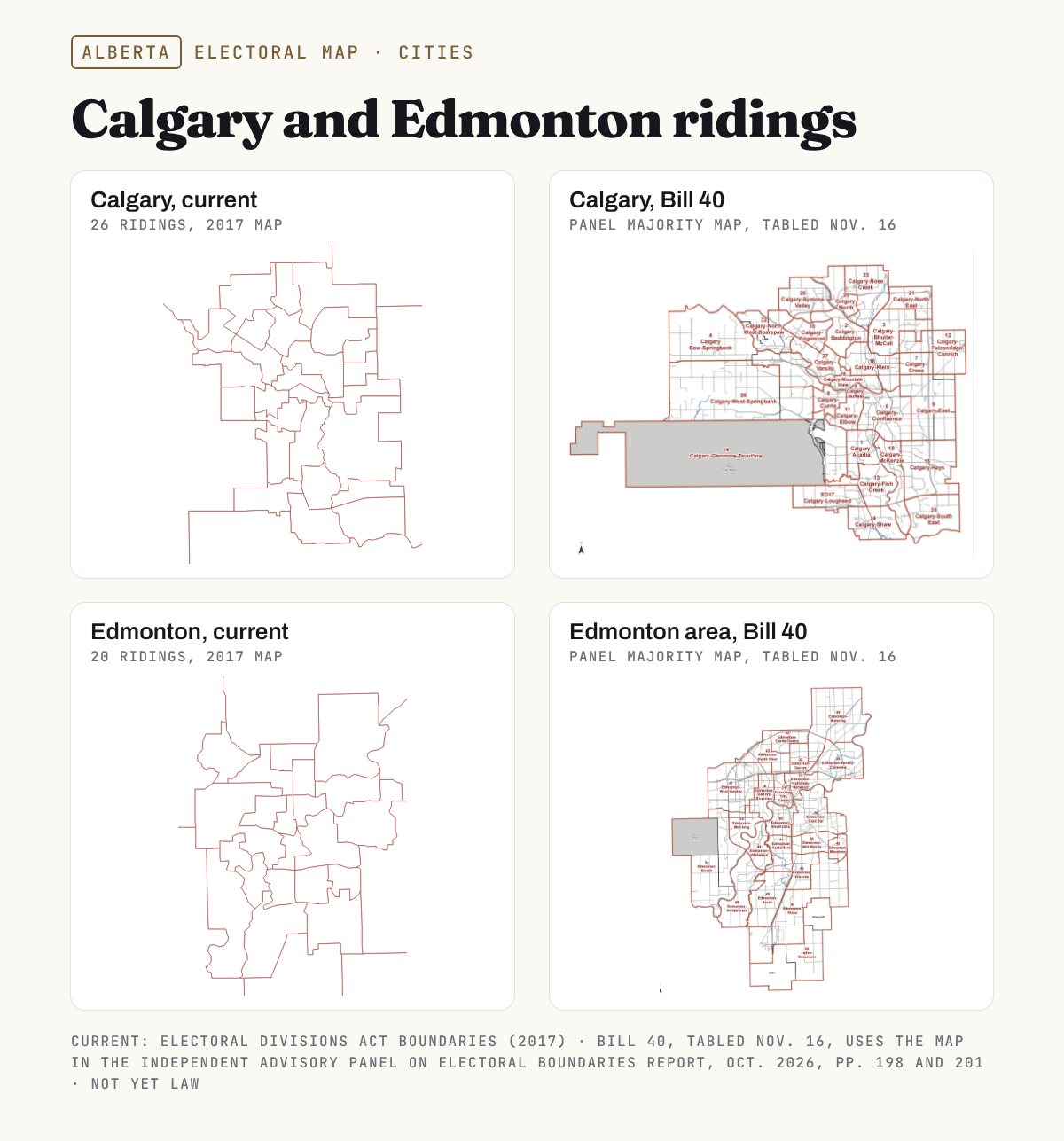
The map becomes a bill. Justice Minister Mickey Amery introduced Bill 40, the Electoral Divisions Act, on Monday, Nov. 16. It would replace Alberta’s 87 ridings with 91, using the map from the advisory panel the government appointed after rejecting the boundaries commission’s recommendations. Amery told the legislature the boundaries were “approved in a resolution passed by the Legislative Assembly,” Hansard shows. “Alberta is growing and changing, and our electoral boundaries must keep pace,” he said, and he called the NDP’s objections “sour grapes,” CBC News reports. NDP Leader Naheed Nenshi calls the map gerrymandered. “If this passes, we’re challenging it in court,” he said, CTV News reports. Premier Danielle Smith said the government will assemble a legal team to defend it.
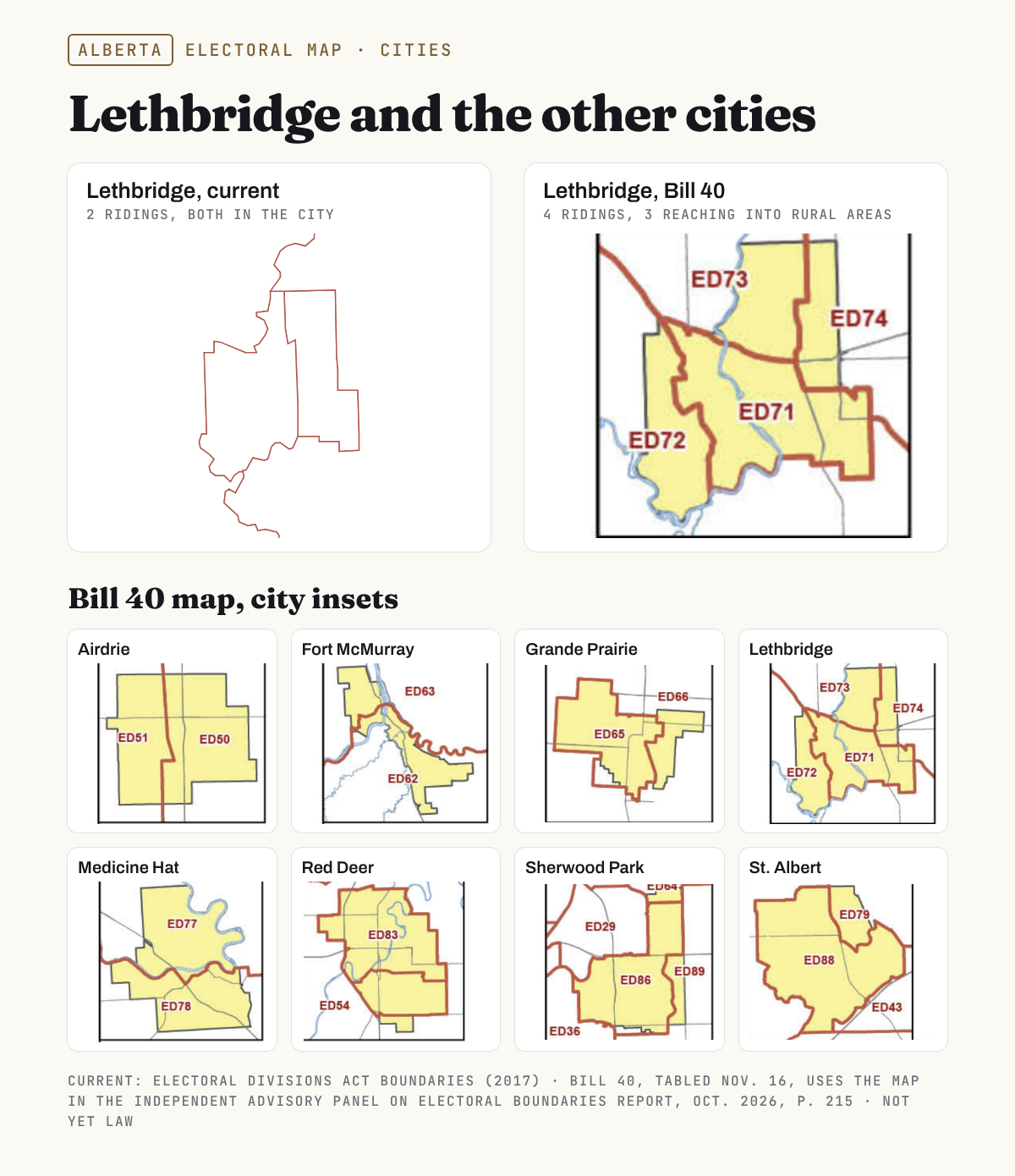
What’s in the map. All five panel members backed restoring two rural ridings the commission had removed, Lac Ste. Anne and Rocky Mountain House-Sundre. A three-member majority also proposed hybrid urban-rural ridings in west Calgary, around Banff and Canmore, and in Lethbridge, which would go from two ridings to four: an all-city Lethbridge riding plus Lethbridge-Little Bow, Lethbridge-Taber-Warner and Lethbridge-Cardston. The two members who dissented wrote that this removes an urban seat and adds a third rural one. In October, Alberta’s chief electoral officer asked the government to keep the current boundaries or postpone the election; Amery declined.
Data centres and new wells. Bill 42, tabled Nov. 18, would keep data centres of 10 megawatts or more at least 600 metres from the nearest home and off irrigated land and the best farmland. Operators would pay for their own power hookups so costs aren’t passed to ratepayers. Projects that already have permits, including Meta’s campus in Sturgeon County, are not covered; the province says about 30 per cent of the 70 data centres in its concierge program could be affected. “Albertans told us what matters most: their communities, farmland and water. We listened,” said Technology Minister Nate Glubish. The bill would also make companies set aside cleanup money for each new well drilled after April 1, 2027. “Every new well drilled in Alberta will have money set aside for its eventual cleanup,” Smith said. It would repeal the 2016 Oil Sands Emissions Limit Act, which never took effect. Jorden Dye of the Business Renewable Centre of Canada said the water limits are good news but power bills “will go up during the bridging period,” CTV News reports. Nathan Ip, the NDP’s critic for technology and innovation, said “70 per cent of AI data centres will still go ahead” under the bill and called for a pause until there is a community-supported plan, the Medicine Hat News reports.
Play Alberta. Alberta Gaming, Liquor and Cannabis is considering selling Play Alberta, the government’s online casino. “No decisions have been made,” Service Alberta Minister Dale Nally said Nov. 16. Information and Privacy Commissioner Diane McLeod said the province’s privacy rules address “most of my concerns,” but a buyer would get “an extremely detailed set of personal information.” Players would get 90 days to opt out.
Procurement investigation. Auditor General Phil Peters can’t yet say when his report on health-care procurement will be released, CP reports. The allegations behind it have not been proven, and the government denies wrongdoing.
Business on immigration. The Alberta Enterprise Group asked the government, in a letter dated Nov. 5 and released Nov. 17, not to legislate immigration changes from the referendum until it consults business.
Bike lanes and LRT. Transportation Minister Devin Dreeshen introduced Bill 43, the Safe and Sensible Roads Act, on Nov. 19. It would block new city bike lanes that take road space from vehicles unless the minister approves them, let the province order some existing lanes removed, and require provincial approval for new or expanded LRT projects. As written, municipalities would pay for removals; Edmonton Mayor Andrew Knack estimates up to $150 million for lanes built in the last decade. Calgary Mayor Jeromy Farkas said the premier’s office told him cities won’t pay. “We’ve got some amendments to propose,” Smith said Nov. 21. NDP Leader Naheed Nenshi called the bill “unbelievable overreach,” The Canadian Press reports.
Proof of citizenship. Smith told UCP members at a virtual town hall that a law requiring proof of citizenship to vote, a referendum proposal, will likely come in the spring. Voters would need a passport, a birth certificate or an Alberta licence with a citizenship marker. Critics say it would make voting harder, The Canadian Press reports.
Also from the government. Bill 41 updates pension, insurance and securities laws ahead of Care-First auto insurance on Jan. 1. The Budget 2027 survey is open until Jan. 4. Albertans whose licences or ID cards expired in the last six months and who can’t get documents can renew with a signed declaration, without the citizenship marker: licences from Nov. 19, ID cards from Dec. 7.
Manitoba, Newfoundland and Labrador, and the rest
Each province and territory has its own legislature. Here’s what each one did, from west to east and then north.
Status for the week of Nov. 23 · legislature calendars and government notices, checked Nov. 20 and 21
PollAbacus Data, New Brunswick
Liberals 44, PCs 32
Decided voters. Government approval: 34 per cent approve, 30 per cent disapprove.
Abacus Data, online, 606 adults, Oct. 28 to Nov. 10 · released Nov. 17
Parliament: The budget passed 162 to 151 on Nov. 19 (story 2). Budget implementation bills come next.
British Columbia: The new Conservative government was sworn in Nov. 20, and there will be no fall sitting (story 3).
Alberta: Bill 40, the riding map, and Bill 42, on data centres and new wells, were tabled (story 4). Bill 41 updates pension, insurance and securities laws. Bill 213, a government MLA’s bill for a volunteer firefighter and search and rescue tax credit, passed second reading. An NDP motion on banked overtime was defeated 12 to 44.
Saskatchewan: Trade Minister Warren Kaeding introduced the Red Tape Reduction and Accountability Act Nov. 19. It requires ministries, agencies and Crown corporations to keep regulatory review schedules and report each year. The province says red tape work since 2014 has saved businesses an estimated $732 million.
Manitoba: A new session opened with a throne speech Nov. 17. Premier Wab Kinew’s government promises laws requiring stores to show unit prices, creating an independent disability advocate and banning AI in real estate, and a “mega deduction” for families in the next budget. It plans to reopen Victoria Hospital’s emergency department next summer and make the shingles vaccine free for seniors. “We have come a long way together in just three years,” Kinew said.
Ontario: The government added a clause to Bill 148, on private career colleges, that would bar lawsuits against the province over its OSAP fraud investigation. OSAP funding has been frozen at all 242 private career colleges since October. “We’re holding these institutions accountable,” said Colleges and Universities Minister Nolan Quinn. NDP Leader Marit Stiles called the bill retroactive, and interim Liberal Leader John Fraser called it “window dressing,” Global News reports. On Nov. 21, Ontario Liberals elected former federal minister Navdeep Bains as leader, with 50.3 per cent to Lee Fairclough’s 49.7 on the third ballot. He doesn’t have a seat and says he will run for one, CP reports.
Quebec: Quebec is the only province to end free flu shots for everyone this season. They stay free for people 65 and older, people with certain chronic conditions, pregnant women and nursing home residents, The Globe and Mail reports. The National Assembly meets Dec. 1.
New Brunswick: An Abacus Data poll released Nov. 17 has Premier Susan Holt’s Liberals at 44 per cent of decided voters and the Progressive Conservatives at 32. Government approval is 34 per cent, disapproval 30.
Nova Scotia: The House isn’t sitting. On Nov. 21, the Liberals elected Becky Druhan, the MLA for Lunenburg West and a former Progressive Conservative cabinet minister, as leader with 68 per cent of points over Amanda Mombourquette, CP reports.
Prince Edward Island: The Progressive Conservative party says it will not hold a vote on Premier Rob Lantz’s leadership. A petition signed by 91 members on Nov. 2 asked for one; after legal advice, the executive concluded the constitution doesn’t require it. Lantz said his offer to meet the signers still stands, The Canadian Press reports. The NDP holds its annual general meeting Dec. 5 in Charlottetown.
Newfoundland and Labrador: The bill eliminating the provincial gas and diesel tax passed third reading Nov. 19. The tax goes to zero Dec. 1, about 8.6 cents a litre on gas and 10.9 on diesel with HST, until a review March 31, 2027. On Nov. 20 the province and Ottawa approved Equinor’s Bay du Nord project, the province’s first deepwater oil development, with a final investment decision expected in early 2027. “Bay du Nord represents billions of dollars in future royalties,” Premier Tony Wakeham said. The fall fiscal update Nov. 23 projects a $78-million surplus for 2026-27, instead of the $688-million deficit in the spring budget, with revenue about $1.5 billion higher than forecast, NTV News and CBC News report.
Yukon: Bill 11, the Yukon Firearms Act, passed third reading Nov. 16 after an amendment in committee and awaits assent. It creates a Yukon firearms advocate, an independent office that would take Yukoners’ concerns to Ottawa and report each year. The sitting ends by Nov. 26.
Northwest Territories: The Assembly returns Feb. 3, 2027.
Nunavut: The fall sitting ended Nov. 5. No more sittings are scheduled this year.
Budgets in Calgary and Edmonton, and a new council in Toronto
Calgary. The proposed 2027 to 2030 budget would raise municipal property tax revenue from existing properties 15 per cent in 2027, about $37 a month for a median-assessed home. It has a $6-billion operating budget for 2027 and a $21-billion capital budget over four years. Council hears from the public and deliberates from Nov. 23 and approves the budget in December.
Edmonton. Council holds a public hearing on its proposed 2027 to 2030 budget Nov. 23.
Toronto. The new council met for the first time Nov. 18 and elected Coun. Ausma Malik as speaker. Mayor Olivia Chow said she would make the city “more caring, more affordable, and safer,” CTV News Toronto reports.
Montreal. The city presents its budget Nov. 24.
Word of the week
Minister of state
A member of cabinet who helps a minister with part of a portfolio, rather than running a ministry of their own.
In Doerkson’s cabinetFor red tape reduction, rural development, mining, housing, labour and emergency management.
Office of the Premier of British Columbia · Nov. 20
Dates to watch
What’s coming up
- Budgets and a recountCalgary and Edmonton budget hearings; Kelowna Centre judicial recount; B.C. NDP MLAs sworn in; N.L. fall fiscal update
- Montreal’s budget
- B.C. Green MLAs sworn inYukon’s sitting ends by this date
- UCP annual general meetingCalgary, Nov. 27 to 29
- N.L. gas and diesel tax endsQuebec’s National Assembly meets
- P.E.I. NDP annual general meetingCharlottetown
- Premiers meet, and six federal byelectionsPremiers in Toronto, Dec. 7 and 8
- Bank of Canada rate decision
Further out
- Alberta’s next general electionSet by law for the third Monday in October
City and legislature calendars · Kelowna Daily Courier · Government of N.L. · Council of the Federation · Elections Canada · Bank of Canada
Public sources only. No predictions.
Every party is reported the same way. Claims are attributed to the people who make them.
From Churchill Strategy
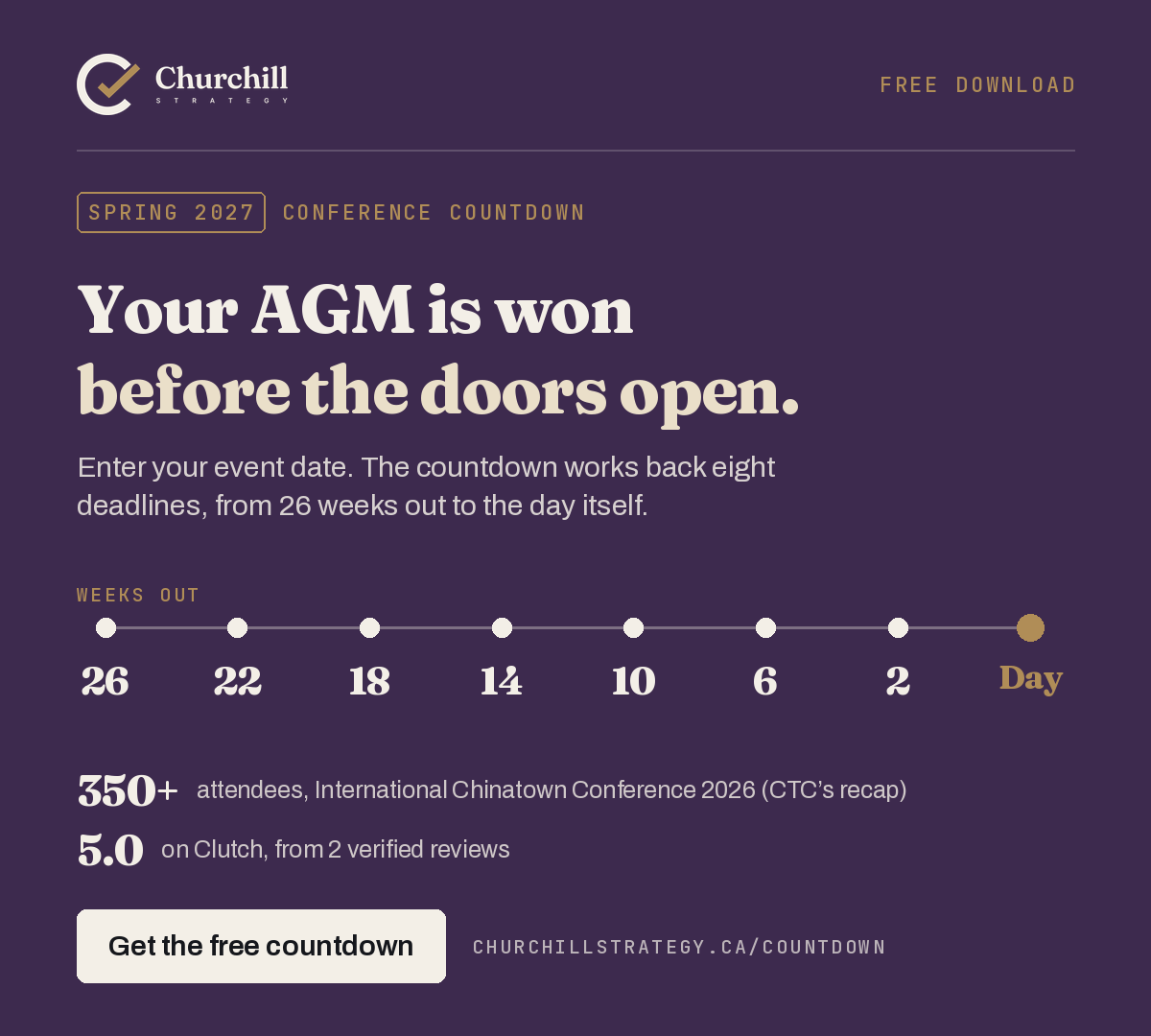
Your AGM is won before the doors open.
Planning a spring AGM or conference? Most of the work is due months before the day: the venue, the agenda, the speakers, the sign-in.
Our free Spring 2027 Conference Countdown takes your event date and works back eight deadlines, from 26 weeks out to the day itself, so you can see what’s due now.
It’s the same countdown we work from as an Edmonton event production firm for Alberta associations and nonprofits. Recent work: 350+ attendees at the International Chinatown Conference 2026 (CTC’s recap).
Get the free countdownFree. Enter your date to see your deadlines, and leave your email for the PDF.
Every Monday
Get Monday Insights by email.
Five minutes on last week in Canadian politics, with a chart for every story. Free, every Monday at 7 a.m. Alberta time. Sign up with the form below.
Questions or a topic you want explained? Email winston.pon@churchillstrategy.ca.
Sources. Trade: The Canadian Press via Global News (Nov. 17); Ministry of Foreign Affairs of China (Nov. 17); The Associated Press (Nov. 16); CBC News (Nov. 16); The Canadian Press via CTV News (Carney and Sheinbaum, Nov. 17); Innovation, Science and Economic Development Canada (Ford Oakville, Nov. 20). Ottawa: Abacus Data (Nov. 22); Liaison Strategies (Nov. 23); House of Commons, vote 196, via openparliament.ca (Nov. 19); The Canadian Press (budget, Nov. 19; Macklem, Nov. 16; PSAC, Oct. 23); Statistics Canada, Consumer Price Index, October 2026, and table 18-10-0004-01 (Nov. 16); CTV News Ottawa (PSAC, Nov. 16); Public Health Agency of Canada, FluWatch+; Canadian HR Reporter (Nov. 19); The Globe and Mail (Nov. 16). B.C.: Office of the Premier (Nov. 20); Victoria News (Nov. 16 and 19); Kelowna Daily Courier (Nov. 13); Elections BC. Alberta: The Canadian Press via Global News (Bill 43, Nov. 19 and 20) and Yahoo News (Smith, Nov. 21); Government of Alberta (Nov. 16 to 18); Medicine Hat News (Bill 42, Nov. 20); The Canadian Press (proof of citizenship, Nov. 22); Alberta Hansard (Nov. 16); CBC News and CTV News (Bill 40, Nov. 16); Independent Advisory Panel on Electoral Boundaries, report (released Nov. 2); CTV News Edmonton (Bill 42, Nov. 18); Office of the Information and Privacy Commissioner (Nov. 17); The Canadian Press (auditor general, Nov. 17); Alberta Enterprise Group (letter, Nov. 5). Legislatures: The Canadian Press (Ontario and N.S. Liberal leaders, Nov. 21; P.E.I. PCs, Nov. 23); NTV News (Beth Penney, Nov. 23); CBC News (N.L. fiscal update, Nov. 23); Government of Saskatchewan (Nov. 19); Government of Manitoba (Nov. 17 and 18); Global News (OSAP, Nov. 17); The Globe and Mail (Quebec flu shots, Nov. 16); Abacus Data (Nov. 17); Government of Newfoundland and Labrador (Nov. 19 and 20); Yukon Legislative Assembly, Progress of Bills (Nov. 16); Yukon News (Oct. 8); Legislative Assembly of Nunavut and N.W.T. calendars. Big cities: City of Calgary; City of Edmonton; CTV News Toronto (Nov. 18); City of Montreal.
Disclosure. Churchill Strategy has worked with conservative parties in Alberta, Saskatchewan and federally, and with a campaign in Alberta’s 2026 referendum. Monday Insights reports results; it does not take sides.